Best Bathroom Flooring: Tile vs Vinyl vs Stone (Pros & Cons)
The bathroom floor takes more abuse than any other surface in your home. Standing water, steam, hair products, cleaning chemicals, bare feet, dropped bottles — and in Kingsport, the humidity swings that come with every season. Choosing the best flooring for bathrooms isn’t about picking the prettiest sample in the showroom. It’s about picking the material that will still look good and stay watertight five, ten, fifteen years from now.
Three materials dominate real-world bathroom remodels: porcelain and ceramic tile, luxury vinyl, and natural stone. They each win on different things — cost, waterproofing, feel underfoot, longevity, maintenance. This guide compares them honestly, with real price ranges and the trade-offs contractors actually see in Kingsport homes, so you can pick with your eyes open.
What Bathroom Flooring Has to Survive
Before the materials, the test. Whatever goes on your bathroom floor has to handle four things, every single day:
- Standing water. Showers splash, toilets sweat, kids flood. A bathroom floor must either be waterproof itself or be sealed so completely that water never reaches the subfloor.
- Constant humidity. Steam from every shower seeps into every seam and grout line. Materials that swell, warp, or grow mold in humidity are disqualified on day one.
- Slip risk. Wet, smooth floors are dangerous — especially for kids and seniors. Texture and slip ratings matter as much as looks.
- Traffic and time. A bathroom floor should last decades, not years. Tearing up flooring is one of the most disruptive parts of a remodel, so this is a buy-once-cry-once decision.
Keep those four in mind as we go through each option. The “best” material is the one that clears all four at a price you’re comfortable with.
Porcelain & Ceramic Tile: The Default Champion
Tile is the default for a reason — it’s the only flooring option here with a genuinely waterproof body (porcelain) and a centuries-long track record in wet rooms.
Pros:
- Truly waterproof. Porcelain tile itself absorbs almost no water (under 0.5%). Water sits on top until you wipe it up — it can’t soak in.
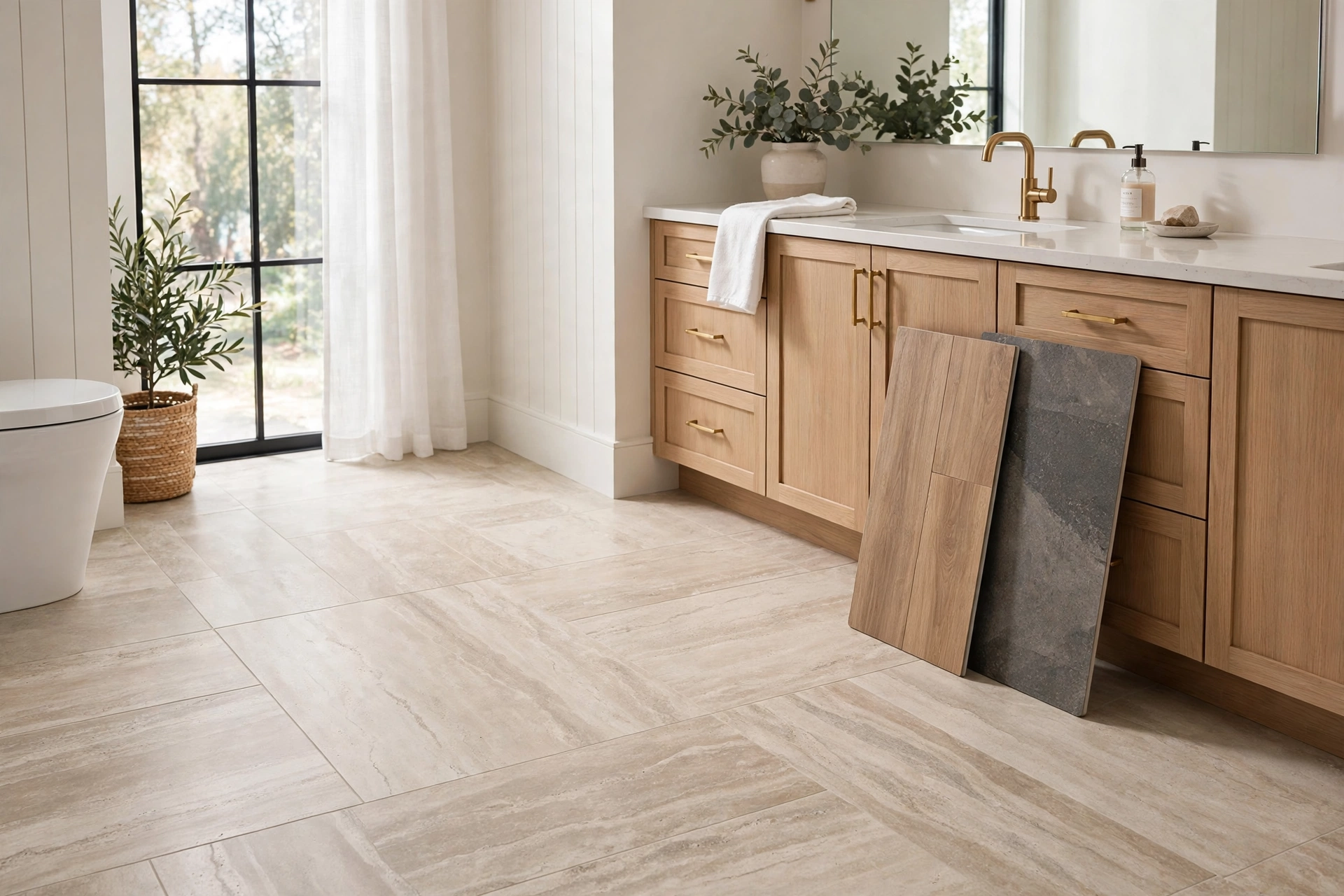
- Huge design range. Wood-look planks, marble-look slabs, hexagons, subway patterns — tile copies every other material on this list, convincingly.
- Longest lifespan. A well-installed porcelain floor lasts 30–50 years. You’ll redecorate around it, not because of it.
- Adds resale value. Tile reads as “real remodel” to buyers in a way vinyl doesn’t.
Cons:
- Cold and hard underfoot. Tile has no give and no warmth. Radiant floor heating fixes this, but that’s a budget line item.
- Grout is the weak link. The tile is waterproof; the grout lines are porous and need sealing (or epoxy grout) to stay clean and stain-free.
- Most expensive to install. Tearing out old flooring, fixing the subfloor, laying cement board, and setting tile is skilled, slow work.
Typical cost: $3–$10 per sq ft for the tile itself; $8–$20 per sq ft installed, depending on tile size, pattern complexity, and how much subfloor prep is needed. These are typical ranges, not quotes — your bathroom’s condition moves the number. Our guide to tile installation cost in Kingsport breaks the labor side down in detail.
Slip tip: look for a tile with a DCOF (dynamic coefficient of friction) rating of 0.42 or higher for wet areas. Matte and textured finishes grip far better than polished ones.
Luxury Vinyl (LVP/LVT): The Waterproof Budget Star
Luxury vinyl plank and tile have come a long way from the sheet vinyl of the 1980s. Modern click-lock LVP is a rigid, layered product with a waterproof core — and it’s become the most popular budget pick for bathroom remodels.
Pros:
- 100% waterproof core. Quality rigid-core vinyl (SPC/WPC) doesn’t swell when wet. Spills sit on the surface.
- Warm and forgiving. Vinyl has slight give, feels warmer than tile, and is kinder to dropped phones and glasses.
- Fastest, cheapest install. Click-lock vinyl often goes down in a day, sometimes right over an existing flat floor.
- Convincing looks. High-end vinyl convincingly mimics wood and stone at a glance — at a fraction of the price.
Cons:
- Surface scratches and dents. Vinyl is softer than tile. Dragging a heavy vanity or dropping something sharp can mark it permanently.
- Shorter lifespan. Expect 10–20 years in a bathroom. It won’t outlive the remodel the way tile does.
- Resale perception. Buyers and appraisers still rank vinyl below tile and stone, even when it looks great.
- Quality varies wildly. Cheap vinyl shrinks, curls, and fades. The $1.50/sq ft stuff and the $6/sq ft stuff are different products wearing the same name.
Typical cost: $2–$7 per sq ft for quality rigid-core vinyl; $5–$12 per sq ft installed. It’s the cheapest way to get a waterproof bathroom floor that looks genuinely good.
Honest caveat: “waterproof” describes the vinyl core, not the floor system. Water can still seep through seams at the edges and around the toilet flange if the install is sloppy. A good installer seals the perimeter — a bad one doesn’t, and the subfloor pays for it.
Natural Stone: Beautiful, High-Maintenance
Marble, travertine, slate, and limestone bring a look nothing else quite matches. Stone floors feel custom and luxurious in a way that shows in photos and in person.
Pros:
- Unmatched natural beauty. Every slab is one of a kind. High-end buyers notice.
- Durability of the material itself. Stone is hard and long-lived — the floors of old European churches are proof of concept.
- Natural texture and grip. Honed and tumbled stone finishes are naturally slip-resistant.
Cons:
- It’s porous. Stone absorbs water and stains unless sealed — and the sealer needs reapplying every 1–3 years, forever. Skip it and you’ll get dark spots, etched rings, and eventually damage.
- Most expensive option. Material runs $5–$15+ per sq ft, and installation is the priciest of the three — stone is heavy, unforgiving, and slow to set.
- Cold, hard, and heavy. Like tile but more so; older subfloors sometimes need reinforcement to carry the weight.
- Etching and staining. Marble and limestone react to acids — toothpaste, citrus cleaners, even some soaps can etch the surface.
Typical cost: $5–$15+ per sq ft for material; $12–$30+ per sq ft installed.
Honest take: stone is a lifestyle choice, not a value choice. If you love the look and accept the sealing routine, it’s gorgeous. If you want a floor you never think about, it’s not for you.
Tile vs Vinyl vs Stone at a Glance
| Porcelain/Ceramic Tile | Luxury Vinyl | Natural Stone | |
|---|---|---|---|
| Waterproofing | Excellent (tile body) | Excellent (core); seams need care | Poor unless sealed regularly |
| Durability | 30–50 years | 10–20 years | Decades, with maintenance |
| Installed cost/sq ft | $8–$20 | $5–$12 | $12–$30+ |
| Comfort | Cold, hard | Warm, forgiving | Cold, hard |
| Maintenance | Seal grout periodically | Sweep and mop | Reseal every 1–3 years |
| Resale value | Highest | Lowest | High (in luxury homes) |
| DIY-friendly | No | Moderate | No |
Which Is the Best Flooring for Bathrooms? Our Honest Recommendation
If you’re asking which is the best flooring for bathrooms for most Kingsport homeowners, our answer is porcelain tile — and it’s not close. It’s the only option that’s waterproof through its entire body, it lasts decades, and it adds the most to your home’s value. Yes, it costs more upfront and feels cold in January. But a bathroom floor is a 30-year decision, and tile is the 30-year material.
Luxury vinyl is the right pick when budget or timeline rules the project — a rental, a quick flip, a second bath, or a remodel where the money needs to go to plumbing and fixtures instead. Buy the rigid-core SPC product from a known brand, have it installed by someone who seals the edges, and it’ll serve you well for a decade-plus.
Natural stone is for the homeowner who wants it because they want it. We install it, it looks stunning, and we’d never talk anyone out of a floor they love — just go in knowing the sealer is a recurring appointment, not a one-time step.
One more thing the showroom won’t tell you: the subfloor matters as much as the surface. Rotten or flexing subfloor ruins tile (cracked grout), vinyl (bouncy seams), and stone (cracked slabs) alike. Any honest bathroom remodel cost in Kingsport includes subfloor inspection and repair — if a quote skips it, that’s a red flag, not a bargain.
Don’t Skip the Prep Work
A few installation notes that apply no matter which material you pick:
- Fix the subfloor first. Replace any water-damaged plywood or OSB, screw down loose boards, and make sure the floor is flat within the manufacturer’s tolerance.
- Waterproof the wet zones. Around the shower or tub, the floor should tie into proper waterproofing — especially with walk-in shower installation in Kingsport, where there’s no curb holding water back.
- Leave expansion gaps. Vinyl and wood-look products expand with temperature and humidity. The gap hides under the baseboard — until someone skips it and the floor buckles.
- Use the right underlayment. Tile needs cement board or an uncoupling membrane; vinyl needs a flat, smooth surface. The wrong underlayment voids warranties.
Still deciding? That’s exactly what a consultation is for. Call (831) 666-1180 or get in touch through our contact page — we’ll look at your bathroom’s condition, your budget, and how you actually use the space, then recommend the flooring that makes sense for your home, not our margins.
Porcelain tile, without question. It’s waterproof through the entire tile body (under 0.5% water absorption), handles constant wetting, and lasts decades. Choose a matte or textured tile with a DCOF slip rating of 0.42 or higher for the shower floor itself.
The rigid core of quality SPC/WPC vinyl is 100% waterproof and won’t swell. But “waterproof core” isn’t the same as a waterproof floor system — water can seep through perimeter seams and around the toilet flange if the edges aren’t sealed during installation. Buy a quality product and have it installed by someone who seals the edges.
Yes, but it demands maintenance. Stone is porous and must be sealed at installation and resealed every 1–3 years to resist water and stains. Skip the sealing routine and you’ll get dark spots and etching. It’s a lifestyle choice for homeowners who love the look — not a set-and-forget material.
Vinyl, by a wide margin. Quality luxury vinyl runs about $5–$12 per sq ft installed, while porcelain tile runs $8–$20 per sq ft installed. Vinyl also installs faster — often in a single day. Tile costs more upfront but lasts two to three times longer, so the lifetime cost gap is smaller than the install quotes suggest.
A properly installed porcelain tile floor lasts 30–50 years — often outliving the vanity, fixtures, and even the homeowner’s taste in grout color. The tile itself rarely fails; when tile floors do fail, it’s usually the subfloor or installation underneath, which is why subfloor prep matters so much.